Friday, June 12, 2015

On Peregrinus, Part III: First Contact

First Contact: The Men of Iron


The People’s Crusade: 


Both the Pope and the Emperor had hoped for an army well led and organized, but many set out on their own and Christ was not their motivation. They marched under the guise of crusaders and terrorized the countryside, most of these bands were eventually destroyed in or around Hungary.  A massive rabble led by Peter the Hermit called the Pauper’s Crusade, departed in mob fashion, and without supplies.  They were comprised of poor men and women, and a few knights.  Albert of Aix wrote:

In response to his (Peter the Hermit) constant admonition and call, bishops, abbots, clerics, and monks set out; next, most noble laymen, and princes of the different kingdoms; then, all the common people, the chaste as well as the sinful, adulterers, homicides, thieves, perjurers, and robbers; indeed, every class of the Christian profession, nay, also, women and those influenced by the spirit of penance—all joyfully entered upon this expedition.

Due to starvation and other motivators, they attacked and robbed the country along the route to Constantinople, over 10,000 are said to have died along the road side due to starvation and exposure.  Chaos followed their march, Albert left an account that tells of a scene of desperation.  The harsh conditions, questionable devotion, and lack of discipline lead to acts of cruel thievery and murder.  The evil actions committed by the “crusaders” were immediately reciprocated by the host country:

They (The Hungarians) fell upon them (“Crusaders”) with cruel slaughter, cut down the defenseless and unarmed and inflicted upon them frightful slaughter, to such an extent (as those affirm for a truth who were present and barely escaped) that the entire plain of Belgrade was filled by the bodies of the slain and was covered with their blood.

Modern society often criticizes the crusade(s) as being an example of the evils religion brings upon the world.  Many Christians even, view this period as a black eye on the Church.  I however see this period as a supreme example of the benefit of Christian Character in contrast of the human condition.  One of the reasons the enemies of Christianity will bring up the crusades in their arguments, is due to the events that occurred on the march to Constantinople but Ekkehard wrote:

Thus the men of our race, zealous, doubtless, for God, though not according to the knowledge of God, began to persecute other Christians while yet upon the expedition which Christ had provided for freeing Christians. They were kept from fraternal bloodshed only by divine mercy; and the Hungarians, also, were freed. This is the reason why some of the more guileless brethren, ignorant of the matter, and too hasty in their judgment, were scandalized and concluded that the whole expedition was vain and foolish.

The first army of crusaders to arrive at Constantinople were the poor, haggard followers of Peter the Hermit.  Emperor Alexius was well aware of their conduct along their journey to his Empire so he denied them entry into the city.  He soon conveyed them across the channel where they were placed in an old fortification near the Turkish line to “await orders” (The real Crusading Army).  It is said that driven by their fanaticism, they disobeyed the Emperor and marched into enemy territory. It is more likely they were driven by a want of supply (greed) and the sense of urgency felt by their leaders as their numbers and discipline dwindled every day they remained idle.  Unprepared for the steppe style of warfare and poorly armed, they were almost completely destroyed by the local Turkish Emir.

                The Turks however mighty and numerous, were far from the united power they would become under the Ottoman banner.  They had inflicted a serious defeat on “Rum” as they called the Eastern Romans, but like the princes of Western Europe, they would rather fight against one another than work together.  Amin Maalouf wrote a fantastic book from the oft overlooked Muslim perspective called, The Crusades through Arab Eyes.  Maalouf describes the harsh world of Turkish politics, and gives a much better insight into the politics of the Middle East than the Crusader accounts do.  Unlike the “Frang,” as the Western Europeans were called, Turkish successions were never smooth transitions of power and were almost immediately followed by civil war.  The Turks’ were nomadic in nature, and thus prefer leaving the governing of their conquered cities to slaves that paid them an annual tribute.  They would destroy irrigated land and create pastures, so both the land and the cultures there suffered greatly under Turkish rule.  Each Emir thought only of increasing his own power, reputation and influence.  Alliances were based on mutual benefit and nothing more.  Treachery was the most common character trait in the East, honor based loyalty was a foreign concept.
                  In July 1096 the rabble under the command of Peter the Hermit entered the recently conquered territory of Kilij Arslan the Sultan of Rum.  (King of the Romans)  Arslan was only 17 years old, but was already trying to make a name for himself by conquering the territory of more famous men.  He was in the middle of just such a campaign when word reached him from his spies in Emperor Alexius’ army (Alexius used Turkish mercenaries) that an army of “Frang” had arrived at an old fort near his capital of Nicaea.  After hearing of the slaughter and pillaging of the countryside around his capital, (where his pregnant wife was living) he lifted his siege rode swiftly meet this strange new threat.

                The rabble had been confiscating supplies in preparation for the siege of Nicaea. Under the pretext of “foraging expeditions,” “crusader” villains slaughtered and robbed men, women, and children of all faith backgrounds.  Perhaps over confident in the lack of resistance they had received, they ventured further and further into the interior. 
“Because of the danger of ambushes and attacks from the Turks, they (Byzantines) forbade Peter and his whole army from marching towards the mountainous region of the city of Nicaea, until a greater number of Christians should be added to their number. Peter heard the message, and he with all the Christian people assented to the counsel of the Emperor. They tarried there for the course of two months, feasting in peace and joy, and sleeping secure from all hostile attacks. and so two months later, having become wanton and unrestrained because of ease and an inestimable abundance of food, heeding not the voice of Peter, but against his will, they entered into the region of the city of Nicaea and the realms of Soliman. (The Turks)  They took as plunder cattle, sheep, goats, the herds of the Greek servants of the Turks, and carried them off to their fellows. Peter, seeing this, was sorrowful in heart, knowing that they did it not with impunity. Whereupon he often admonished them not to seize any more booty contrary to the counsel of the Emperor, but in vain did he speak to a foolish and rebellious people.  But the Teutons, (Germans) seeing that affairs turned out so well for the Romans (Not the Romans we think of today, but possibly men from the old Germanic-Roman territory: Alamannia- just my guess, but they were certainly Latins)  and the Franks, and that they returned unhindered so many times with their booty, were inflamed with an inordinate desire for plunder.” –Albert of Aix

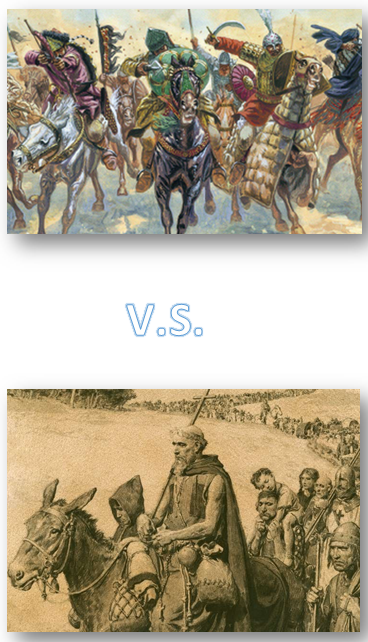
Unfortunately for Peter’s forces, they had failed to realize that the Greek, Arab, and Armenian inhabitants they had so effortlessly destroyed, were not regular Turkish forces.  I had always imagined All the crusaders as being far superior to All the Muslim forces.  In my mind’s eye I pictured them something like this:


No contest right!?  Turns out, though there is some truth in this comparison, it’s a bit off.  The Turkish forces, had their own version of knights.  In tactics, skill and appearance they were more like the Mongolian horde than the forty thieves of Arabian Nights.  Though the “Frang” Knights were notoriously fierce and unrivaled in melee combat, the rank and file of Peter’s army were little more than a starving mob of angry peasants.  The reality looked more like this:


The result was just as you might expect, almost the entire army, the pilgrims, and family members that followed were slaughtered or sold into slavery.  A few thousand managed to take refuge in a nearby coastal fort, and though in ruins, they were able to hold off the forces of Arslan long enough for the Byzantine navy to rescue them. 

                                                The Real Crusade: 

The Battle of Dorylaeum


Arslan had lost hardly any men defeating The People's Crusade.  He returned to his capital and celebrated his victory.  Once back to his usual self-aggrandizing shenanigans, he ignored reports that additional Crusaders had arrived near his capital.  To appease the troubled messengers, he sent a small detachment of cavalry.  After his last experience with the “Frang” he was confident the small force he sent, was more than enough to destroy the newly arrived infidels.  A few days passed when, what remained of his cavalry returned with news of their defeat and that the city was now besieged!

                What the Sultan of Rum had failed to realize was that multiple “armies” marched out on crusade, but only one was the official Crusader Army.  This army represented nearly all the Crown heads of Europe, with their private armies of picked men.  Aside from the thousands of volunteers, civilians, and pilgrims, the Army that marched out of Constantinople, was a massive experienced force of warriors, and merciless raiders.  

Let's step out of the middle ages and into the future. Imagine for a moment,  you are the governor of a small state or county in a post-apocalyptic America.  You have a small army of professional soldiers of varying background and experience, as well as hordes of armed locals.  


You show up to the battlefield expecting an army of transient bandits, only to find yourself facing a  professional army of infantry and armored cavalry, headed by thousands of Navy Seals.  To make this proposed sci-fi thriller even more ridiculous than a Kevin Costner film, said army is lead by the clones of Gen. Patton, Sam Houston, Stone Wall Jackson, & George Washington. All of them are hell bent on your destruction…  


This is the situation Arslan found himself in!  He was wise enough to patch things up with his enemies, and unite against a common foe but he was wholly unprepared to face the force that awaited him.  Hoping to take advantage of his vast numerical superiority (A point that wikipedia and I differ on), and the element of surprise, he attacked the besiegers at their weakest point.  

The weakest point by his definition was the point with the smallest number of armed troops, and those furthest from re-enforcement.  Unfortunatly for Arslan and his allies, it was Bohemund's camp.  Arslan expected the crusaders to break and flee under such a ferocious surprise attack but Bohemund was a verteran.  He ordered his knights to dismount and they successfully formed a line of battle, protecting the noncombatants and poorly armed troops from the Turkish mounted archers.  The Turks discovered to their horror, that arrows couldn’t pierce the knights' armor.  What was worse, when the troops engaged in close combat, they were easily cut to pieces. Bohemund fought constantly for some 7 hours, until eventually being relieved by the other crusader leaders.  After this engagement these Knights were simply called: "The Men of Iron." Their line of battle: "The moving fortress"

The battle raged all day, the Turks were well supplied and the Crusaders were cut off.  The battle was finally decided when the Papal legate, Bishop Adhemar of Le Puy, maneuvered his forces under the cover of nearby hills to the enemy's rear. Once near the Turkish supply camp, he attacked the Turks from the rear, burning thier camp and scattering the muslim horde.  Many of you may be thinking, "What's a Papal Legate"?  You may think it strange that a Bishop, and Papal legate (Pope's enforcer) would be leading troops into battle. Interestingly, back in the good ol' days, there used to be Warrior Bishops.  I'm not sure what they looked like in battle.  Art from this period typically shows them in robes and halos, but I think Bishop Addy (That's what his friends called him) looked something like this:


I’ve talked about the appearance of the factions involved in this epic contest quite a bit, but don't just take my word for it.  Anna Comnena, the daughter of Emperor Alexius I, left us a fantastic reference.  She was best known for her beauty and for writing a biography of her father: The Alexiad.   A fascinating, though doubtless exaggerated, account of the Byzantine Empire.   Her account is important to this article because she describes a Norman knight.  She does so, so vividly it’s like being pulled into the pages of history, back in time, and into his actual presence. What follows is her description of  Bohemund, Prince of Taranto at her father’s court (The place where all the nobles hung out):

Now [Bohemond] was such as, to put it briefly, had never before been seen in the land of the Romans, be he either of the barbarians or of the Greeks, for he was a marvel for the eyes to behold, and his reputation was terrifying. Let me describe the barbarian's appearance more particularly – he was so tall in stature that he overtopped the tallest by nearly one cubit, narrow in the waist and loins, with broad shoulders and a deep chest and powerful arms. And in the whole build of the body he was neither too slender nor overweighted with flesh, but perfectly proportioned and, one might say, built in conformity with the canon of Polycleitus

(Polycleitus was a famous artist in ancient Greece, best known for his sculptures of Greek gods/goddesses) 

His skin all over his body was very white, and in his face the white was tempered with red. His hair was yellowish, but did not hang down to his waist like that of the other barbarians; for the man was not inordinately vain of his hair, but had it cut short to the ears. Whether his beard was reddish, or any other colour I cannot say, for the razor had passed over it very closely and left a surface smoother than chalk...
 His blue eyes indicated both a high spirit and dignity; and his nose and nostrils breathed in the air freely; his chest corresponded to his nostrils and by his nostrils...the breadth of his chest. For by his nostrils nature had given free passage for the high spirit which bubbled up from his heart. 

A certain charm hung about this man but was partly marred by a general air of the horrible... He was so made in mind and body that both courage and passion reared their crests within him and both inclined to war. His wit was manifold and crafty and able to find a way of escape in every emergency. In conversation he was well informed, and the answers he gave were quite irrefutable. This man who was of such a size and such a character was inferior to the Emperor alone in fortune and eloquence and in other gifts of nature.
                
Her description of Bohemund must’ve been the inspiration for Ragnar’s character in the History Channel’s hit show: Vikings.


The Fall of Nicaea


 After his defeat, Arslan sent a messenger to the governor of Nicaea telling him to act according to his own best interests.  The governor promptly struck a deal with Emperor Alexius, and secretly transferred the city back into Byzantine control.  The crusaders awoke the next morning to find Byzantine colors waving over the city.  Some were happy at the peaceful end but the Normans, and Teutons were enraged at having been robbed of glory and plunder.  There was no bloodshed, the Sultan’s wife and child were cared for by Emperor Alexius. Arslan fled into the desert and began to spread the word to the other Muslim lords of the impending threat to their recent conquests.

Bohemund’s mere presence may have been enough to weaken the knees of young princesses and the walls of his enemies but his ambition and political cunning were less amiable.  Princess Anna writes:    

For when this man of evil design (Bohemund) had left his country in which he possessed no wealth at all under the pretext, indeed, of adoring at the Lord's Sepulcher, but in reality endeavoring to acquire for himself a kingdom, he found himself in need of much money, especially, indeed, if he was to seize the Roman power. In this he followed the advice of his father (Duke Robert Guiscard) and, so to speak, was leaving no stone unturned. Moreover, the Emperor, who understood fully his wicked intention and perverse mind, skillfully managed carefully to remove whatever might further Bohemund's ambitious designs. Wherefore, Bohemund, seeking a home for himself in the East and using Cretan scheming against Cretans, did not obtain it. For the Emperor feared lest, after obtaining power, he would use it to place the Latin counts under obligation to him, finally thus accomplishing easily what he wished. But since he did not want Bohemund to surmise that he was already discovered, the Emperor misled him by this hope: "Not yet," he said, "has the time come for the thing which you say; but after a little it shall come about by your fortitude and trust in me."

From about 1080-1085, Bohemund had commanded most or the Norman knights that would go on to follow him on “crusade”, during his father’s attempts to take the Byzantine throne for himself.  Robert was the effectual king of Viking (Norman) Italy.  Bohemund was ambitious for two historically known reasons:
  1.        Being the first born and likely favored son of Robert, he was to inherit his father’s kingdom.  Unfortunately Robert’s shield maiden and 2nd wife Sikelgaita, wanted her son to inherit the kingdom and was vehemently against the war with Byzantium.  Bohemund was dis-inherited by his younger half-brother Roger II, King of Sicily.
  2.        Bohemund had pledged to his father, that he would carry on his dream of conquering Byzantium. His actions on and after the crusade corroborate this narrative.

It’s obvious that the leaders of the Crusade had various intentions but the Normans’, specifically Bohemund’s intentions, heavily influenced and marred Byzantine-Crusader relations.  The peaceful transition of the city of Nicaea back into Byzantine hands infuriated the Normans, even though they had pledged to return control of ALL formerly Byzantine cities back to Byzantine control.  Nicaea was the turning point in relations between the Greek and Latin powers, the mistrust and political intrigue almost destroyed the entire expedition. 

Friday, May 1, 2015

On Peregrinus, Part II: Getting to know the crusaders

The Call for Crusade


Villains and history

At first glance we not only see a man using “Vikings” to remove the Pope currently in Rome and replace him, but Urban also claimed to have the crown of Christ and his authority to pardon sin. Clergy proselytized murderers, that they might redeem themselves by killing the enemies of God.  Or so it seems when one views the events and facts of the Call for the Crusades without context. Timeline study is no way to understand history, for instance:  It is widely believed that FDR wanted to participate in World War II.  The economic stimulus of wartime industry provided a means to bring America wholly out of the Great Depression.  It is a matter of fact that, in 1941 the Japanese told the office of President FDR they were going to attack.  Naval intelligence intercepted communications confirming that a Japanese fleet had indeed mobilized and was somewhere in the Pacific.  The newest ships, and fleet of Air craft carriers were sent out of Pearl Harbor not long before the attack took place, and the vessels left there were ignorant of the impending attack. Without context these facts thus presented, make a convincing case that FDR allowed the Japanese to kill thousands of Americans for no other reason than to further his agenda. The truth however, was that poor communication in military command and government had caused the intelligence to fall through the cracks.


Perception is as influential in reading history as it is in our everyday life.  It is easy to find examples of “Christians” that waged cruel war for seemingly petty reasons or simply for greed.  Constantine, Charles Martel, and Charlemagne are but a few.  These men killed without mercy in the many wars they waged.  It is appalling to modern civilized society to think of such things, but how many of us have fought?  Most men and many women attended public schools and had to find their place in the social hierarchy.  Some gained popularity and respect through great achievements while others, lacking talent and good will, gain respect through intimidation.  In my own experience in public schools, I found that fights were regular and the result always the same; One got their way and one was beaten into submission.  What would have been the outcome had arms been available? Furthermore what would the result of such a contest be if every strong armed schoolyard bully had an army at his/her disposal?  With that in mind are we really so different, so much more civilized and refined than those that came before us?  There is an old saying: An argument between neighbors is war between princes.  It’s likewise pointless to debate the piety of Constantine, Charles Martel, and Charlemagne because only God knows their heart. The only thing that we can say for certain is that they acted similarly to all others of their era. What separates them from their peers is not their kind hearts, and civilized manner but the results of their achievements.  They saved Christendom from certain destruction and they died flawed, forgiven men believing in Jesus Christ.   


Deus Vult ( God Wills It! or as the gentlemen say: "I'll see your Jihad and raise you a crusade")


In the late 11th century, Roman Emperor Alexius I wrote to various western authorities, including Pope Urban. Alexius begged the Pope to send knights which might be used as mercenaries, to defend against the Muslim conquest of his lands.  The call for additional forces went largely, though not completely, unanswered because the western powers were either defending against Norman invasion or were busy increasing their own power.  Pope Urban recognized a golden opportunity and seized it.  He wanted to solidify his position as the legitimate Pope, be restored to Rome, and stop the senseless violence that had been ravaging the Frankish kingdoms since the death of Charlemagne.  He went on what politicians today call, the campaign trail

“He (Pope Urban) saw, moreover, the faith of Christendom greatly degraded by all, by the clergy as well as by the laity, and peace totally disregarded; for the princes of the land were incessantly engaged in armed strife, now these, now those quarrelling among themselves. He saw the goods of the land stolen from the owners; and many,
who were unjustly taken captive and most barbarously cast into foul prisons, he saw ransomed for excessive sums, or tormented there by the three evils, starvation, thirst, and cold, or allowed to perish by unseen death. He also saw holy places violated, monasteries and villas destroyed by fire, and not a little human suffering, both the divine and the human being held in derision. When he heard, too, that interior parts of Romania were held oppressed by the Turks, and that Christians were subjected to destructive and savage attacks, he was moved by compassionate pity; and, prompted by the love of God, he crossed the Alps and came into Gaul.”-Fulcher

He toured France, Italy, and the parts of Germany where he could safely do so, condemning the sins of men and the German “Anti-Pope.”  He preached many sermons but the sermon that became legendary, was that given at Clermont. Here it is, at length, as recorded by Fulcher of Chartres:

"Dearest brethren," he said, 'I, Urban, invested by the permission of God with the papal tiara, and spiritual ruler over the whole world, have come here in this great crisis to you, servants of God, as a messenger of divine admonition. I wish those whom I have believed good and faithful dispensers of the ministry of God to be found free from shameful dissimulation. For if there be in you any disposition or crookedness contrary to God's law, because you have lost the moderation of reason and justice, I shall earnestly endeavor to correct it at once, with divine assistance. For the Lord has made you stewards over His family, that you provide it with pleasant-tasting meat in season. You will be blessed, indeed, if the Lord shall find you faithful in stewardship. You are also called shepherds; see that you do not the work of hirelings. Be true shepherds and have your crooks always in your hands. Sleep not, but defend everywhere the flock committed to your care. For if through your carelessness or neglect the wolf carries off a sheep, doubtless you will not only lose the reward prepared for you by our Lord, but, after having first been tortured by the strokes of the lictor, you will also be savagely hurled into the abode of the damned.

In the words of the gospel, Ye are the salt of the earth'? But, it is asked, If ye fail, wherewith shall it be salted?' Oh, what a salting! Indeed, you must strive by the salt of your wisdom to correct this foolish people, over-eager for. the pleasures of the world, lest the Lord find them insipid and rank, corrupted by crimes at the time when He wishes to speak to them. For if because of your slothful performance of duty He shall discover any worms in them, that is to say any sins. He will in contempt order them to be cast forthwith into the abyss of uncleanness; and because you will be unable to make good to Him such a loss. He will surely banish you, condemned by His judgment, from the presence of His love. But one that salteth ought to be prudent, foresighted, learned, peaceful, watchful, respectable, pious, just, fair-minded, pure. For how can the unlearned make others learned, the immodest make others modest, the unclean make others clean? How can he make peace who hates it? If anyone has soiled hands, how can he cleanse the spots from one contaminated?

For it is written, If the blind lead the blind, both shall fall into the pit. Accordingly, first correct yourselves, so that without reproach you can then correct those under your care. If, indeed, you wish to be the friends of God, do generously what you see is pleasing to Him. "See to it that the affairs of Holy Church, especially, are maintained in their rights, and that simoniacal heresy in no way takes root among you. Take care lest purchasers and venders alike, struck by the lash of the Lord, be disgracefully driven through narrow ways into utter confusion. Keep the Church in all its orders entirely free from the secular power; have given to God faithfully one-tenth of the fruits of the earth, neither selling them, nor withholding them. Whoever lays violent hands on a bishop, let him be priests, or nuns, and their servants, or pilgrims, or traders, and shall have despoiled them, let him be accursed. Let thieves and burners of houses and their accomplices be excommunicated from the church and accursed. Therefore, we must consider especially, as Gregory says, how great will be his punishment who steals from another, if he incurs the damnation of hell who does not distribute alms from his own possessions. For so it happened to the rich man in the Gospel, who was punished not for stealing anything from another, but because, having received wealth, he used it badly. "By these evils, therefore, as I have said, dearest brethren, you have seen the world disordered for a long time, and to such a degree that in some places in your provinces, as has been reported to us (perhaps due to your weakness in administering justice), one scarcely dares to travel for fear of being kidnapped by thieves at night or highwayman by day, by force or by craft, at home or out of doors. Wherefore, it is well to enforce anew the Truce, commonly so-called, which was long ago established by our holy fathers, and which I most earnestly entreat each one of you to have observed in his diocese. But if any one, led on by pride or ambition, infringes this injunction voluntarily, let him be anathema in virtue of the authority of God and by the sanction of the decrees of this council."


There were many sermons preached at Clermont.  Pope Urban preached there for several days, it would’ve been called revival had it taken place in modern evangelical America. In his account Fulcher highlights something that is all too often omitted from the history books, the role of the Church.  There were nobles present at Clermont but the target audience was clergy, not kings.  Why would he speak as though the clergy were accountable for the sin and lawlessness of kingdoms rather than those who bore the crown?  As you might recall from previous posts, the Western Roman Empire did not fall suddenly, but due to poor policy, political weakness, corruption and more than a few socio-economic catalysts, it declined to the point of collapse.  People lost faith in the government, the politicians and influential citizens in Rome either went to Byzantium (The Eastern Roman Empire) or chose to serve one of the Roman Dux, later known as Dukes. 

The end of centralized government meant the end of safe travel.  The decline in travel and trade resulted in a decline in the exchange of ideas and technology.  Civilization in Europe became siloed, limited according to the resources and fancies of individual kingdoms. The Papal crown, as it were, was needed because Western Europe had nothing holding it together.  The Church was the last thread of the old Roman stability and civilization. It was charged with restoring God’s peace by acting as the conscience of kings and moral compass of his people.  If the Kings and the people were cruel, it was because the clergy was ineffective.  The only thing preventing a true dark age, was the light of the Church. 

Knights and Warriors: getting to know the Peregrinus


Unlike the Eastern Roman Empire, 11th century Western Europe offered limited career opportunities.  Wealth and power was almost completely limited to the nobility.  Farming, skilled trades, and mercantile/shipping were the most common means of employ but all depended on a well-armed patron for security.  Trades were taught through apprenticeships and difficult to come by.  E.g. the son of a farmer was most likely to become a farmer.  If he wished to seek his fortunes elsewhere he could either go to sea, raid, or become a mercenary soldier (Which involved raiding and sea/river going).  Mercenaries were often poor knights and men that made their living by attacking and robbing the rivals of their patrons.  Some became successful and earned lands and titles. They in turn hired warriors of their own, who likewise hoped to win fame, fortune and titles for themselves.  A glimpse of medieval society can be seen in this quote attributed to Pope Urban:

"Let these who for a long time have been robbers, now become soldiers of Christ. Let those who once fought against brothers and relatives now fight against barbarians, as they ought. Let those who have been hirelings at low wages now labor for an eternal reward. Let those who have been wearing themselves out to the detriment of body and soul now labor for a double glory. On the one hand will be the sad and poor, on the other the joyous and wealthy; here the enemies of the Lord; there (on crusade) His friends."

Most of us hear the word, knight and think of: 
but there's a difference between the military culture in the age of Chivalry in Chaucer’s time, or that of the Gentlemen Soldier of the Victorian era and the “Knights of the Dark Ages” that embarked on the first crusade.  The Knights of the Round Table, and other such fanciful depictions are not all together absent in the 11th century or any other time for that matter, but such virtue and honor was hardly the standard.  When Rome “fell” in the west, it was at the hands of Christianized barbarians, not pagans.  The only organized power left standing was the Catholic Church.  The clergy’s role as mentioned before was to influence the warlords of Europe to act with Christian character as best they could. It is for that reason that Pope Urban spent the better part of his sermon at Clermont on the failures of the clergy in their sacred charge.

 Given the nature of petty kingdoms and serfdom, there were no nations.  Loyalties varied from king to noble, & there were no standing armies like those of more recent history.  Armies were expensive to maintain, knights were well trained and fairly disciplined but the bulk of the army of this period were not full time soldiers.  Medieval infantry or “men-at-arms” varied in skill and professionalism, most received little formal training; this is especially true of the crusades which called for every single, able bodied man to take up arms and join the army bound for the Holy Land.


Knights were the politicians of the age, and though they acted more like mafia dons than congressmen, they were the official representative of their people.  it is true that some indulged themselves in acts of cruelty, but as a whole they were held to fairly high standards of character, and accountability by the Church.  The positive affect of the Church on medieval Europe is, I think, most evident during the period of the First Crusade.  Challenges and remonstrance echoed through Europe and were heartily answered.  Imagine, yourself as knight holding court with your peers.  A priest, whose role, station and authority was well known by all is given audience and begins as follows:

“You, girt about with the badge of knighthood, are arrogant with great pride; you rage against your brothers and cut each other in pieces. This is not the (true) soldiery of Christ which rends asunder the sheep-fold of the Redeemer. The Holy Church has reserved a soldiery for herself to help her people, but you debase her wickedly to her hurt. Let us confess the truth, whose heralds we ought to be; truly, you are not holding to the way which leads to life.

You, the oppressors of children, plunderers of widows; you, guilty of homicide, of sacrilege, robbers of another's rights; you who await the pay of thieves for the shedding of Christian blood—as vultures smell fetid corpses, so do you sense battles from afar and rush to them eagerly. Verily, this is the worst way, for it is utterly removed from God! If, forsooth, you wish to be mindful of your souls, either lay down the girdle of such knighthood, or advance boldly, as knights of Christ, and rush as quickly as you can to the defense of the Eastern Church. For she it is from whom the joys of your whole salvation have come forth, who poured into your mouths the milk of divine wisdom, who set before you the holy teachings of the Gospels.”

Entreaties like these were made in courts all across Europe.  Some took up the cross to escape debt, death, or imprisonment.  Some for promise of spoil, or to indulge themselves in pre-pardoned atrocities.  Many more embarked out of a sense of duty and piety alone.  The nature of the true motivation of each nobles’ oath may be discerned easily enough by his actions, many of which were recorded by multiple sources on both sides.

Rules of Engagement:

The Catholic Church had not yet developed the moral code of knighthood that is known today as Chivalry.  (That’s right, Chivalry would not exist without Christianity) It’s easy to assume that there were rules of war after reading the statement above but perhaps rules is too strong a word.  Etiquette is a more accurate description, as rules imply consequences.

Good Battle Etiquette:


  As previously mentioned, the first crusade took place before the age of chivalry. The viking age had ended just a few years prior so ROE varied according to the fancy of the belligerents.  Generally the knights claiming to be Christian had the good motives and were also just rulers (Just does not = nice).  One might reasonably expect the following from an army well lead by a Christian knight:

  •  An enemy if found at a disadvantage, even in flight was fair game (Live to fight another day? I think ye not!). 
  •  Robbing from your enemy, or indigenous noncombatants was accepted and considered by both parties (yes those being robbed knew their lot) as the fortunes of war (Do not pass woe, do not collect 200 Denarii).  
  • Quarter was typically expected by and given to knights and or men of noble birth (Thanes,  Earls, etc.)  Most nobles were worth more alive, and were ransomed back at a fair price.  War could be a profitable game for the nobility, and many poor knights moved their way up the food chain in this manner. A noble that was found cast a shore in Norman or Danish territory for example, fully expected to be relieved of all his valuables, and to be held until his ransom was paid.
  •  If besieging a city, the city was first offered terms of surrender (Not always unconditional).  If the governor of the city determined to resist, he (Attacking or defending leader) would usually request that the women and children be allowed to leave unmolested before the attacks commenced, and full quarter was expected to be given to them.    

Poor Battle Etiquette: aka what to expect from an invading Norman army


 Indiscriminate Rape and murder of innocent people was considered bad form by most men-at-arms and nobles.  However all those remaining inside a besieged city expected such actions.  Even if the knight was himself against rape and murder  given the character, circumstances, and discipline of the rank and file, he could do little to prevent it.  The nature of soldiers of the era (and nearly all those thereafter) were well known. When the common people heard an army was going to be in the area (armies rarely arrived before news of their approach) the typical medieval villager would have three options:
  1.   Send a representative to parlay with the leader of the army for safety.
  2.   Flee into the forest/wilderness or the local castle
  3.    Stay hoping the army would leave you and your family unmolested. 

Many villagers opted for option three because they were rarely the targets of aggression, being the local food source, the invaders benefited from their productivity just as their local lord did.  Unfortunately bands of villains, which could be found in any army as they are even today, would stray from the main body and terrorize the countryside simply for the pleasure of mischief.  Fleeing into the forest was typically the best option for two reasons: 

 1. because the castle may be taken and those within were often all put to the sword.  
 2. because even if the leader of the attacking force promised to leave your village alone,          foraging parties from the attacking force or those of your "friends" in the castle, may              come requisition your goods and......  your ladies. 


Warrior culture, especially that of the Danes, Normans & Germans (Gauls or Teutons as they were called) were still influenced by, if not loyal to, the old gods of war. Desperation and greed were all important factors to the atrocities that happened in the crusades, just as they are in modern day warfare and are even common place in our own inner cities.  If you’re reading this and saying to yourself: “What does this dude know about what life was like in  the Middle Ages!?”  I could tell you that, as a fan of history, I’ve studied the period for years. I could tell you that, I’m using direct quotes from crusaders themselves and other eye witness accounts from Greeks and Arabs alike,  but that probably wouldn’t convince you.  The argument here isn’t that the crusaders were all good people, or that atrocities are to be excused because, as they say “That's their culture.”  Neither were they the warped, right-wing, Christian terrorist some would have you believe.  The argument is one of human nature and the culture and conditions of life in the ashes of the old Western Roman Empire. 

Should you require a lesson, I recommend that you put on your finest suit and take an evening stroll through Sunny Side in Houston, Ninth Ward New Orleans, or O Block in Chicago.  If you survive your visit, come back to this blog and please post your commentary.  There are good, noble people and leaders in every culture, but “culture” is a little word with a big meaning and human nature is one of the few things that never changes. Mankind can be brutal, war was and always will be terrible.  It brings out the very best and the very worst in us.  The people of the Middle Ages knew more of human nature than any anthropologist living in the United States today! 


The end result of a Viking raid


Ekkehard writes:

“Yet, since each one may be known by his fruits, even as wolves are recognized under sheep's clothing, those same deceivers, especially these who are still alive, may be questioned as to what port they sailed from, according to their vows, and how they crossed the sea without ships, or in what battles and places they worsted so many pagans with their small forces, what fortresses of the enemy they took there, and, finally, at what part of the wall at Jerusalem they had their camp, and so forth. And those who have nothing to answer as to the alms which they have hypocritically taken from the faithful, or as to the many bands which they have misled and murdered for plunder, and, above all, as to their own apostasy, may be compelled to do penance.”

Mobilization

This map is flawed but it does show the routes taken by the main army.  Hugh, Raymond, Godfrey, & Bohemond were not the only knights in command of The Crusade. The only error I suppose is that Nicaea and all the territory below it, should also be colored green.  The armies of Islam were nearly at the gates of the Byzantine Capitol. (The gateway to Western Europe)

        The most famous knights of the western world made preparations for the journey.  They appointed stewards for their lands, recruited men to boost their number, raised funds, often to the point of financial ruin. They chartered ships and or made arrangements for a long overland march with one of the two bodies of forces that made up the official Army. The Crusader Army was made up of  nobility from nearly every, if not every, Christian kingdom in western Europe.  It was divided into two parts, one was to march through the lands of the Teutons, the Hungarians, and finally the Greeks.  The other marched through Rome, left Italy by sea, and marched on to Constantinople.  Some knights, bigger in deed than in purse, made little provisions and hoped to win riches along the way, or perhaps carve out a kingdom for themselves.  A great many others, embarked on the journey without making any preparations whatever.  A cult-like priest named Peter the Hermit recruited thousands of men, women and children of all classes, and characters with the promise that what ever their past sins were, all would be forgiven if they left immediately for the Holy Land, trusting in God alone to provide for their needs. Other war-bands mobilized as well but only one army was destined to reach the end of the journey.  

Friday, March 27, 2015

On Peregrinus, Part I: Medieval Europe

On Peregrinus I: Medieval Europe


I thought about calling this post: “The First Crusade”, but realized that it didn’t quite fit my thesis.  The Crusades is a topic oft referred to by those attacking Christianity and or religion in general, and I didn't want to give the impression that this post is some sort of attempt at an apologia of the Crusades.  My goal with this post is to attempt to describe the Peregrinus, which is Latin for Crusaders, and the culture in the times which they lived and the role Christianity played in that time.  This is a controversial period, often used by the enemies of Christianity or religion as an example of the evils of The Faith.


Jumping to the defense of the crusades is not the appropriate response to any argument, it's simply too complex.  The easiest rebuttal is to use examples of more recent history, as it is easily relatable.  For instance, Atheism and its governing counterpart, communism, has killed more people in the last 100 years than Christianity has killed since its inception (roughly 100 million people exterminated in less than 50 years.)  Another historical attack used on the church are the wars of religion in France and Germany, which gave rise to the humanist philosophy that motivated the French revolution.  The philosophers of the French revolution also influenced Marx and Lenin.


It’s true that the Protestant vs Catholic wars were terrible, and while some fought for self-defense and religious freedom, both sides often went against the teachings of Christ, to say the least.  The French Revolution made religion illegal and relying on their own moral code they slaughtered thousands, finally culminating in the Napoleonic Wars which brought the whole of Europe to her knees.  The common theme in all of this is the human condition.  If all the world were Christians in practice, there would be no wars.  Unfortunately there is too much temptation to put ourselves above other, thus world peace will continue to elude us. Those that pursued the folly of trading liberty for peace or conceded to evil and aggression in history, either brought about more cruelty upon themselves or were destroyed by more enterprising men.  It's no coincidence that Utopia (Greek for “no place”) was chosen as the title of Thomas Moore’s famous book.


The simple truth is this: Christianity doesn't kill people, people kill people.  Just to clarify, I do not defend religion, I defend Christianity. (See Mathew 5)  There were and ARE religions out there that encourage/promote living by the sword.  Religions of the sword were an important part of the Crusades but Christianity is not one of those, as I hope you will see.  There are so many parallels to our own society and lessons to be learned from this extraordinary time. This period is so complex  that even being as brief as I can, a single post is just too great a burden on the reader, so I've broken it up into shorter parts.  I hope you find it interesting because I think its forehead smacking good! (The topic and evidence, not necessarily my rendition of them...)

The Carolingian Empire


By 500 A.D. the Roman Empire in the west had fractured into petty kingdoms ruled over by Romanized and non-Romanized “barbarians”.  Various movements to restore the Empire occurred such as the Merovingian Dynasty (A.D.470-750), but the most successful was Charlemagne (Charles the Great).  Charlemagne unified/pacified the barbarian tribes of Europe.  Various Northmen, Gauls, and Goths/Franks became part of a unified “Frankish” Empire:


By the year 800 A.D., Charlemagne had reconquered much of the European territory that Constantine had conquered, forced the pagan people to convert to Christianity, and restored law and order.  He was eventually crowned “Holy Roman Emperor” by the Pope, a title that the German monarchs would keep until after World War I.  
The Norse, Slavic, and Avars (Hunnic Tribes) resisted fiercely however and a fairly solid boundary was set for the empire along their borders. The armies of a new religion called Islam had been narrowly prevented from conquering France by the previous dynasty and Charlemagne secured his empire from further encursion though strategic alliances and by fortifying the northern Iberian Peninsula.  He also shared dominance of the Italian Peninsula with the Eastern Roman Empire that had thus far, retained most of their ancient power and prestige.
The Carolingian Empire declined sharply after the death of Charlemagne, largely due to the Germanic custom of dividing land evenly between sons.  His sons began fighting each other for complete control over the once unified Empire, which served to further undermine the imperial restoration which had been achieved by their father.  As the remaining kingdoms fought amongst themselves, a semi-new threat emerged that signaled the end of Frankish dominance in Europe, The Viking Invasion.

The Vikings


The Vikings were largely Northern European peoples very similar to the Saxons and other Scandinavian/Slav/Gaulic seafaring peoples. They (Angles and Saxons) had been used by Rome, a few hundred years prior, to fight the Breton/Celts and others.  New technology arrived around 790 A.D. which allowed the Scandinavian raiders to venture further to sea than ever before. Some scholars teach that not only were Christians unaware of the existence of these fierce warriors, but the Vikings were likewise surprised.  I find that view difficult to believe, considering the evidence of at least secondary trade, and the wars with Rome/Charlemagne pitched Christians and the Pagan Northmen against each other.  There is also surviving correspondence between the kingdoms of Britain referencing their own barbaric Saxon history and their surprise at the Pagans' ability to navigate the open sea.  Bishop Alcuin, describes the attack on Lindisfarne to King Ethelred of Northumbria (One of the Kingdoms of England near York)
“Lo, it is nearly 350 years that we and our fathers have inhabited this most lovely land, and never before has such terror appeared in Britain as we have now suffered from a pagan race, nor was it thought that such inroad from the sea could be made.  Behold, the church of St. Cuthbert spattered with the blood of the priests of God, despoiled of all its ornaments; a place more venerable than all in Britain is given as a prey to pagan peoples.  Who does not fear this? Who does not lament this as if his (God’s) country were captured?  Foxes pillage the chosen vine, where there was the Praise of God, now there are the games of the Gentiles; the Holy festivity has turned to morning.”
To better understand this era and its people, I imagine a post-apocalyptic America.  The conflict settled, peace restored by local powers and city states that engage in fairly regular mini-wars over resources, but no serious campaigns.  Armies consisted primarily of conscripted bands of the poorly trained supporters/servants of local warlords.  Additional troops were levied from semi-professional mercenaries often paid in plunder.  Now that I think about it, Road Warrior must have been inspired by medieval history.
 

In fact the Vikings resembled modern day biker gangs in many ways. Bishop Alcuin provides a brief description of them as he admonishes the fashion trends of the era:

“Consider the dress, the way of wearing hair, look at your trimming of beard and hair, in which you have wished to resemble the pagans.  Are you not menaced by terror of them whose fashion you wish to follow?”
Viking is a term that usually refers to Swedish, Danish, and Norwegian seafaring peoples (aka Pirates).  Their religion glorified strategy, intrigue, courage, and strength.  Viking women were just as fierce as the men.  The men were expected to fight and couldn’t get much attention from the ladies until they had proven themselves in battle. 

Every Viking hoped to one day die in battle, ascend to Valhalla and feast with Thor, Odin, and etc.  There was little land in Scandinavia, and the soil was difficult to cultivate forcing the Vikings to depend on limited trade and piracy for sustenance.  In a few generations the Vikings had conquered, or at least: terrorized, settled and then influenced most of Medieval Europe.  Ivar, Bjorn, and the other alleged sons of the famous Viking raider Ragnar dominated most of England and Ireland. Meanwhile, Rollo conquered northern France and Belgium founding the kingdom of Normandy. 

The Vikings found the Christian kingdoms of England easy pickings because they put much of their wealth in isolated, undefended monasteries.  The English Kingdoms, being un-unified and slow to adapt to the Viking method of warfare were almost completely conquered by the “Danes.”  The Saxon King Alfred the Great, using old Roman tactics and discipline, eventually regained much of the Saxon dominance of southern England (Wessex) after soundly defeating the Danish forces at the battle of Edington (886 A.D.).  After the battle and baptism of the Pagans, an agreement with the Vikings finally resulted in peace, diffusion, and assimilation. 
  

            If history teaches us anything it’s that, peace is but a respite of hostility, When King Edward “The Confessor” (kin to Saxons, Danes, and Normans) died childless, his extended family battled for the crown.  The victor was William the Bastard, Duke of Normandy.  He became the new King of England and though nominally Christian, he completed the work his grandparents had started by conquering most of England.  He established the Norman dynasty, ruling (at least nominally) over England, Ireland, and most of modern day France.  King William officially brought the “Viking age” to a close in 1066.


The Normans

Norman was the word used by the Frankish people to describe Vikings, roughly translated as “North Man.”  Rollo, a famous Viking, conquered a large part of what is today northern France sometime in the 9th century.  Rollo was defeated by the king of France and to guarantee peace he married the young princess.  Rollo and his queen ruled over a mighty kingdom of north men, aptly named Normandy.  As the “Great Heathen Army” was ravaging England, the Vikings used their French colonies to support their inland river incursions, as well as conquests in the Mediterranean.  The Vikings had assailed the French before in 799 A.D., only a few years after the first recorded attack in England at Lindisfarne. Charlemagne and his heir Pippin created a series of river defenses to guard against such incursions but Ragnar, well informed of the instability caused by the Frankish civil war, circumnavigated the Frankish rivers and successfully sacked Paris.  Ragnar set the standard for marine invasions but Rollo set the standard for long term conquest.  The Vikings-Normans were officially Christian by 911 A.D. but continued to raid for sport and spoil.

The Six Dux of Normandy, Falaise Square:

 
Rollo
 
William Longsword
 
 
Richard the Fearless
 
 
Richard II the Good
 
 
Richard III
 
 
Robert the Magnificent
 
 King William “The Conqueror”
 
Not long after the founding of Normandy, it is believed that either a friend or extended family member of Rollo named Hiallt was given a barony in his kingdom.  Haillt was the patriarch of the House of Hauteville, which sailed into the Mediterranean and terrorized coastal cities from North Africa, to Italy and even led successful campaigns against the Eastern Roman Empire.  While the Norman “Duke” was busy conquering England, the small barony of Hautville's knights were busy building their own kingdom in Sicily and Italy.  After disagreements between the Pope and the Holy Roman Emperor (King of Germany and Saxony) the HRE invaded Rome and put his own Pope on the holy throne.  The exiled Pope fled to his Norman allies in southern Italy, the Norman pirate turned King of Sicily, Roger Borsa, sent his nephew with an army toward Rome. The HRE returned to Germany but the two powers could do little more than achieve a stalemate, thus the Western Christian world was left with a Norman Pope and a German Pope, each disavowing the other.  (The Eastern Roman Empire viewed “the Pope” as a Bishop.)
 

Pope Gregory, (The Pope backed by the Normans) died while still in exile in Norman occupied Italy.  His successor was Pope Urban, by all accounts a good and just man.  Urban was the new Pope but was still forced to live in exile under the protection of his Norman patrons.  He recognized the mess that Europe was in, and was appalled by the suffering caused by hundreds of years of greed induced conflict.  He was also frustrated by his lack of power caused by the German HRE and his rival for the Papacy.  Urban and the rest of Europe was well aware of the scourge of the east, many appeals had been made to the new conquerors as well as to The Emperor.  The Eastern Roman Emperor Alexius, had been using western knights and even Vikings as mercenaries for years


Man wearing replica Byzantine (Eastern Roman Empire) Varangian Guard (Viking mercenary) armor
      
A new people called the Turks conquered the Sassanid Persian Empire, and being recently converted to Islam, began to invade the rest of the middle and near-east from the eastern steppes.  These hunnish zealots conquered land regardless of religion and destroyed anyone perceived as a threat.  All non-Muslim rulers were forced to convert or be put to the sword.

Turkish noble and man at arms

Pilgrimages were no longer allowed, and the once vibrant, beautiful, Greco-Roman Middle East suffered greatly.  Normans had weakened its control over the Mediterranean, Sunni Muslims had conquered Roman North Africa, and the Turks had taken Jerusalem, Rum, and were fast approaching Constantinople. The Roman army was defeated, corruption was rampant, and the Empire found itself in serious trouble.